The Long Way Back To Print
I didn’t come to surface pattern design in a straight line. I came back to it.
In 2002, I was a design intern at Betsey Johnson in New York City. It was the kind of internship you don’t forget — long days fueled by coffee and Red Vines, interns doing everything from cleaning up after the office dog to dressing models backstage at Bryant Park shows. At the time, everyone felt famous. I took photos of models I was convinced were household names, though now I couldn’t tell you who most of them were. I do still have one photo of a very young Beyoncé with Betsey — proof of how surreal that moment in fashion history feels in hindsight.
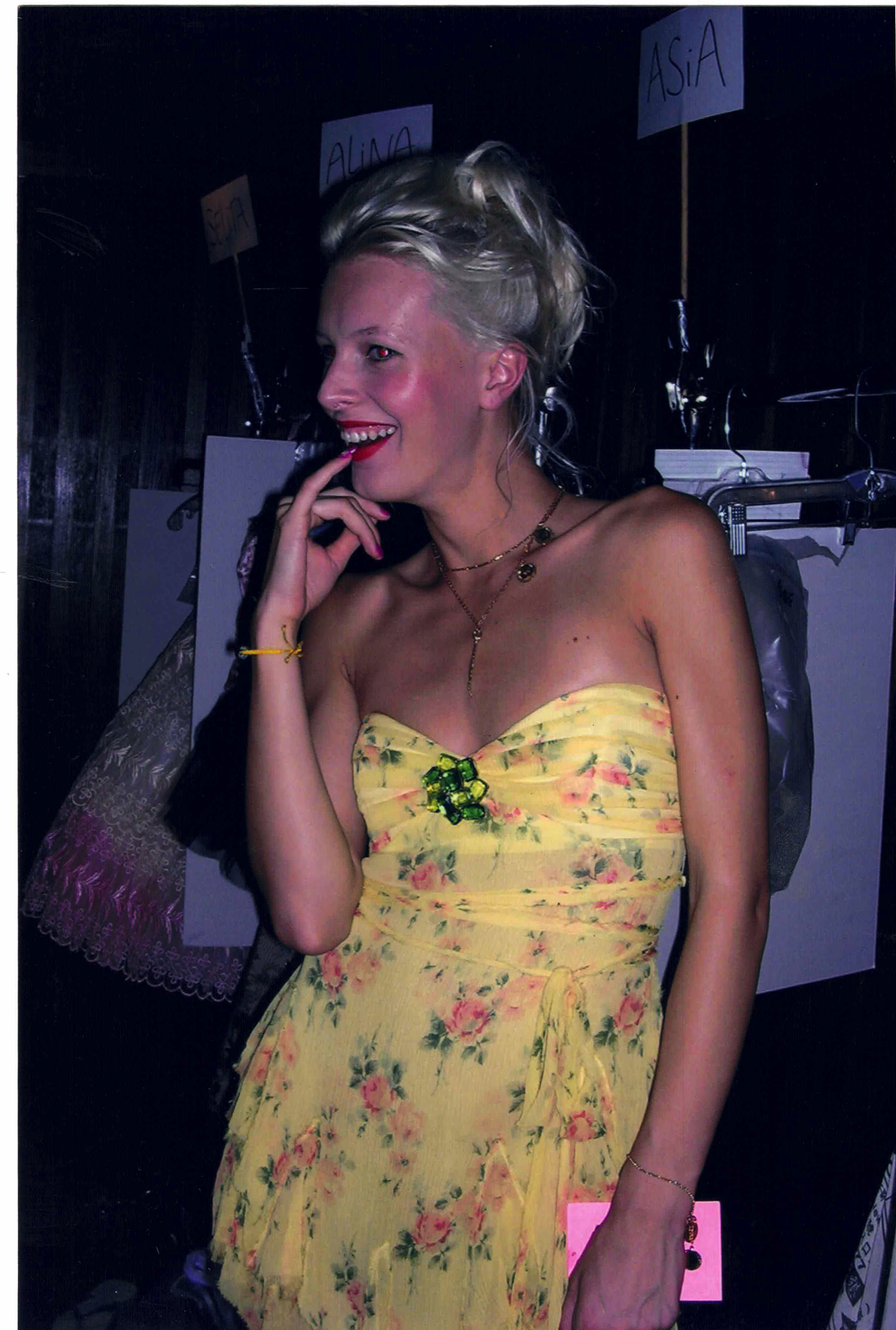
Model Photo taken during NY Fashion week 2002/2003 NYC
Day to day, the job was simple: find out who on the design team needed help, and with what. One afternoon, someone asked if I knew how to use U4ia. My degree from the University of Illinois Urbana–Champaign was a Bachelor of Science in advertising, with a minor in costume design. There was no formal fashion design program, but technical fluency was required — the kind of software skills expected of an art director. So when the question came up, I said yes.
That “yes” placed me next to a newly hired freelance print designer. He was quiet, deeply technical, and largely uninterested in fashion in the way most people at Betsey Johnson were. His role was to recolor and rebuild prints for the Spring collection, and he was asked to walk me through his process so the work could eventually be handled in-house. I learned how to adjust palettes, rebuild layouts, and refine color until the tones felt right.
I loved it — the precision, the intuition, the way color could completely shift the mood of a print.
At one point, Betsey’s stylist passed by, glanced at my screen, and casually remarked that this was something people did professionally — that print design was its own discipline within the industry. It wasn’t advice so much as an observation, but it stayed with me. At the time, though, my ambitions were pointed elsewhere. I wanted to design clothing. I wanted to build something visible and my own.
Years later, that instinct led me to launch a women’s golf and activewear line. I designed the collections, built the brand, and self-funded for as long as I could. Running that business was a seventy-hour-a-week job just to break even — demanding, creative, and deeply educational. I learned what it meant to carry an idea all the way through production, marketing, and sales.

Print development for my own womenswear line —
years before I realized print was always the center of my practice.
But a pattern emerged. The part of the process that consistently energized me wasn’t managing inventory or chasing margins. It was building the collections themselves — creating color palettes, developing artwork, shaping the visual language of a season. Over and over, I was pulled back to print as the center of gravity.
By 2024, as I faced the reality that continuing the golf line wasn’t sustainable without significant capital, I stopped asking what I should do next and started asking what I had always loved most. The answer had been there for years.
In February 2025, I enrolled in the Immersion Surface Pattern Design certification program with Bonnie Christine. This time, the decision wasn’t reactive or romantic. It was deliberate. I wasn’t starting over — I was returning with experience, clarity, and a deeper understanding of how print lives in the real world.
Looking back, surface pattern design was never a detour in my career. It was the thread running through it — from recoloring prints at Betsey Johnson, to building collections for my own brand, to the work I create now.
Today, print is no longer a supporting act. It’s the foundation.
And Ellie Day Studio exists to give that work the space, intention, and storytelling it always deserved.